
As a network specialist for over 35 years , I can ‘think in binary’ can make quite complex subnet / supernet calculations in my head, from years of looking at IP addresses and immediately identifying whether they are on the same network or need to route etc.. almost seeing the world in green 1’s and 0’s like the character ‘Neo’ in the film ‘The Matrix’
But what if computing wasn’t built on twos at all, but instead a 3 state architecture, where it was no longer just ‘On or Off’ but also a mythical 3rd state between the 2. So rather just 1 or 0, we would have -1, 0, and 1, a Traffic light compared to a light bulb if you like, equating to 3 voltage states low, mid & high. Adding this 3rd state drastically increases processing power while reducing the circuitry and power required for it.
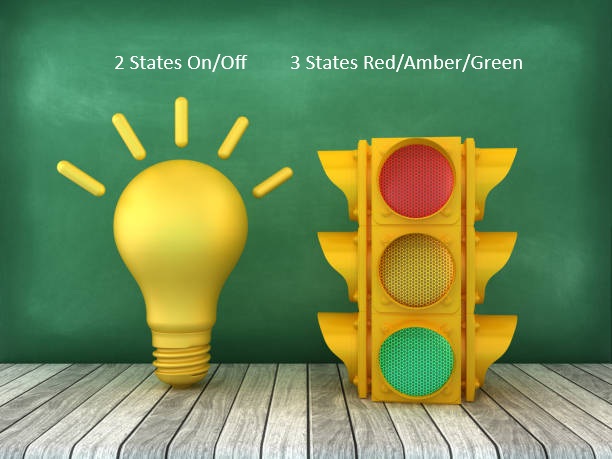
For example we all know a 32 BIT IP address provides 4.29 billion unique combinations of 1’s and 0’s (2^32) but add a 3rd state and now that 32 TRIT IP address provides about 1.85 quadrillion unique addresses (3^32)
But obviously changing the fundamental building block on which practically all technology is based, would be a challenge, hence the much simpler solution of just extending the existing 2 state binary addressing scheme and call it IPv6 in order to overcome IPv4 scale limitations as well as introduce additional features.
So perhaps we have missed the boat with regards to introducing 3 state architecture as the IT standard, but there could well be a time where it makes absolute sense to adopt it within an AI pod to drastically improve performance and reduce power requirements, and after all it’s power which is generally the limiting factor on scaling out and locating AI solutions.
The concept of Ternary computing is nothing new, the Russians built a Ternary computer called ‘Setun’ as a research project back in 1958, but like the Beta Max / Blu-Ray of its time it just didn’t get the adoption against the far more popular and standard ‘VHS’ / Streaming of Binary based systems, despite being superior in many ways.
Another challenge with the 3 state architecture is being able to clearly identify each state, an easy situation in a ‘is it On or is it Off’ world but not so easy with 3 states, factor in noise, signal variables and hardware compatibility and the margin for errors are almost non existent, but with modern isolation materials like Gallium Nitride (GaN) or Gallium Arsenide (GaAs) within the transistors this is now far more efficient.
So in the future it maybe the case that the AI ‘Backend for GPU to GPU communication is Ternary based within the AI Pod, with the conversion to standard Binary signalling done at the Pod edge to maintain global connectivity standards. If you think about it this is pretty similar to how a GPU converts CPU instructions but at a Pod scale level. And if having a different type of backend network that wins out because of superior performance sounds unlikley, just look up InfiniBand 😊
Closing thought, If binary gave us the Internet, could ternary give us sustainable AI?

 UCSguru.com
Pingback: Can Thinking in Threes Solve AI’s Power Problem? – Real World UCS
Pingback: What’s next for AI Infrastructure? | UCSguru.com